
Part II | Neutral brand descriptions and the offer
A neutral brand description is not created by shortening the About Us page. You need to separate the actual scope of activity from brand claims, then translate it into products, services and solutions that correspond to real decision situations. This part explains how to move from a brand description to a structured offer without feeding models an expected result.
In part one of this guide, we defined the researched brand, market, language, domain and entity boundaries. We removed sales language, separated facts from claims and established why manual description building gives people the greatest control over the foundations of the research.
This is only the beginning.
A company name and description alone are not enough to build useful scenarios. People do not ask models only about brands. They ask how to solve a problem, choose a product, assess a service, understand implementation conditions, reduce decision risk or compare alternatives.
The next layer of Identity therefore needs to show:
what the brand actually offers
who may make decisions about particular parts of the offer
which goals, criteria and constraints shape those decisions
which products matter to a particular persona
which entities may be genuine alternatives
where competition actually occurs
This is where a general company description becomes a market model that can be researched.
How to write a neutral brand description
A good description does not need to be long. One to three paragraphs are usually enough if they answer the fundamental questions:
what the researched entity is
which category it operates in
which market it serves
what it offers
which audiences or sectors it serves, where this can be verified
which relationships need to be understood to identify the entity correctly
which limitations matter
The description should identify the brand, not sell it.
Not good
An innovative company with many years of experience, offering comprehensive, high-quality solutions tailored to customer needs. Thanks to its committed team and continuous attention to market feedback, the brand sets standards in its industry.
Once the company name is removed, this description could apply to hundreds of organisations. It does not define the category, market, scope of the offer or boundaries of the researched entity.
Better
A Polish company that sells, advises on, installs and services residential and industrial doors, gates, automation systems and loading-bay equipment. It serves individual customers and businesses in local and regional markets. It is an authorised partner of a manufacturer whose selected products it uses in its projects, while remaining a separate entity.
Why is this description better? Because it can be verified. It explains what the company does, who it serves, which market it operates in and which organisational relationship may cause confusion.
Remove marketing filler
Buzzwords sound safe, positive and professional. But they only sound that way. They carry little information. Their problem is that they grow in almost every brand description, taking the place of information that actually matters.
This category includes, among others:
innovative company
comprehensive offer
highest quality
modern solutions
individual approach
trusted partner
committed team
listening to customer needs
solutions tailored to needs
many years of experience, unless it relates to a specific and material fact
It is worth testing every sentence against four questions:
does it contain information that can be verified
does it help identify the entity, offer, market or limitation
could it appear unchanged in the descriptions of a hundred other companies
does it describe the brand, or suggest how the brand should be judged
If a sentence fits almost any company or tries to establish a preferred judgement, remove it.
It is also worth remembering that keywords, category terms, entities and relationships perform different functions. The article Keywords are not entities illustrates this distinction well. Identity is not about collecting attractive phrases. It is about building an unambiguous model of the researched area.
Do not position the brand against competitors
A brand description should not include statements such as:
“offers more flexible service than large companies”
“is a local alternative to expensive chains”
“stands out through higher quality and faster servicing”
“is among the most advanced providers in the country”
Even if the organisation uses such arguments in its communications, they are not a neutral description of the researched entity. They may influence how scenarios are constructed and distort the later assessment of the brand’s representation in large language models.
Competitors have a separate section. They should also be described factually, by identifying their category, market, business model and the scope of overlap between offers.
Put simply, Identity is not the place to prove that the researched brand has an advantage over them. It is not a poem for the board.
If we want to test whether models spontaneously perceive a brand as innovative, flexible or better at servicing customers, we cannot first enter those judgements into the foundations of the research. The purpose of the research is to reveal the brand’s representation, not reproduce the self-presentation supplied to it.
Do not conceal gaps
A complete form does not always mean a well-prepared form.
If we do not know whether a particular service is still available, whether a product is offered in the researched market or whether a brand genuinely uses a particular alias, there are several honest options:
check an additional source
ask the owner of that area
mark the information for confirmation
exclude it from the current scope
return to it when the Identity is updated
Do not turn probable information into certainty simply to avoid leaving a field blank. Here, a person has one important advantage over a generative model: they can say, “I do not know that yet,” without feeling the need to fill the gap with three paragraphs of plausible-sounding text.
An explicit gap is visible and can be resolved. A fluently written falsehood can remain an invisible error throughout the research.
Quality control before moving to the offer
Before approving Brand Info, check:
whether the name identifies exactly the brand you intend to research
whether aliases refer to the same entity
whether the brand has been merged with its owner, group, partner or distributor
whether the domain is official and appropriate for the researched market
whether the B2B, B2C or hybrid model reflects the scope of the project
whether e-commerce has been enabled only where purchasing genuinely takes place online
whether the description includes the category, offer, market and material relationships
whether superlatives, claims and empty buzzwords have been removed
whether the description avoids positioning the brand against competitors
whether every important fact has a source
whether uncertainty has been marked rather than disguised
whether someone who knows the brand has approved the scope
If the answers are positive, you have created the first layer of a reliable reference model.
This is not yet a complete Identity. A brand begins to function in research only when it is connected with its offer, the people making decisions and real market alternatives. We move to those relationships now.
Do not copy website navigation into the product list
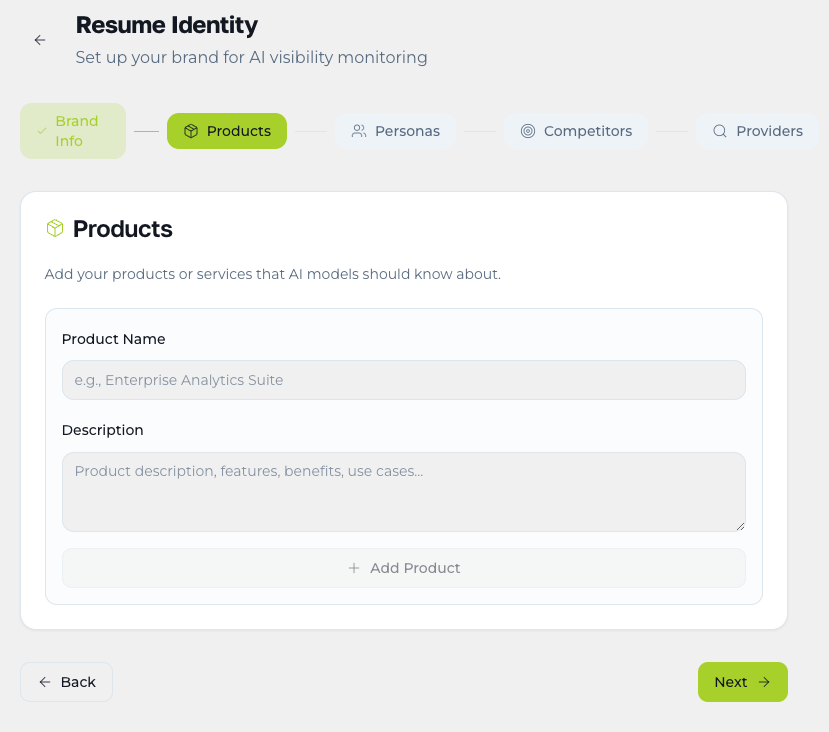
The Products section contains two basic fields: name and description. The simplicity of the interface does not mean that you should simply copy the structure of a website’s navigation.
Navigation is created for many reasons. It may reflect a company’s organisational structure, the history of the website, SEO requirements or an established sales approach. It does not always correspond with how a potential customer recognises a problem and looks for a solution.
Identity needs a research structure:
offer group → product, service or solution → use case and decision context
For each item, establish:
the name used by the brand or a neutral category name
the type: product, service, solution, line or offer group
function and use case
market or availability limitations
audiences or usage situations, where these can be verified
source of information
Remember that the description should remain neutral. A product field is not the place for phrases such as “highest quality”, “groundbreaking technology” or “unmatched convenience”. If you state a benefit, it should follow from a specific function or documented use case.
Find the right level of detail
The most common mistakes sit at two extremes.
Too broad
A company supplying building equipment is described in a single phrase:
doors, gates and automation
This item combines several different decisions. Buying a residential garage door, selecting a high-speed industrial door for a warehouse, accepting a fire door and repairing an automation system are not the same scenario.
Too detailed
Every dimension, colour, material, remote-control model and finish variant becomes a separate product. The result is a long list that looks impressive but adds no new decision context. If two variants are assessed by the same person, in the same situation and against the same criteria, they usually do not need to be separated in Identity.
The right level lies between these extremes. A separate item makes sense when it represents a distinct problem, use case, group of criteria or selection process.
Example: an offer for homes and industrial facilities
Consider an anonymous company that sells, advises on, installs and services solutions for homes, warehouses and industrial facilities.
A useful structure might include:
gate automation and operators
garage doors
industrial doors
external doors for homes
technical and fire doors
access control systems
loading-bay equipment
consulting, selection and installation
servicing, maintenance and repairs
This list naturally separates products from services and preserves different decision situations. It does not, however, divide every door or gate by colour, dimension or an individual technical parameter.
The descriptions can specify that selecting an industrial door depends, among other things, on usage intensity, opening dimensions, insulation, traffic organisation and the control method. For servicing, they can identify diagnosis, repair, adjustment, replacement parts, modernisation and maintenance. These details help explain the scope. They are not a marketing judgement about quality.
The example also shows why a supporting service should not disappear within a product description. Someone may be looking not only for a door or gate, but also for measurement, installation, commissioning or later servicing. Each of these needs may lead to separate questions addressed to AI.
Example: one brand, several ways of using the offer
For an education or personal development brand, the offer may have a different structure:
free self-guided tool
paid digital materials
thematic workshops
group event
one-to-one sessions
course preparing participants for professional practice
mentoring for people who have completed the course
All of these items may relate to the same method, but they correspond with different needs, stages and participation conditions. Someone exploring a subject independently is not making the same decision as an applicant for a certified course. A certified practitioner developing their practice is not the same audience as someone attending a one-off event.
Why does this matter? If the entire offer were placed under the label “courses and personal development”, these differences would disappear from the research model.
A product should describe scope, not positioning
A product description should answer:
what the item is
which problem it solves or function it performs
in which situations it is used
who it is available to
which important limitations it has
whether it requires a previous stage, qualification or another product
It should not answer on behalf of large language models:
whether the product is the best
whether it is more advanced than competitors
whether it offers exceptional quality
whether customers love it
whether the brand sets market standards through it
It is worth repeating: if we want to research whether such assessments appear in generative AI responses, we cannot first introduce them as part of the product definition.
A clearly defined entity and offer make it easier to build scenarios, assess response accuracy and distinguish a genuine representation issue from an error in the research setup. This is the same principle that underpins a rigorous AI visibility audit.
In part III, we move on to personas, assigning the right products to them and defining competitors within specific decisions.