
Part I | Research foundations and Brand Info
You can collect hundreds of responses from ChatGPT, Gemini, Perplexity and other systems and still learn nothing reliable about your brand. All it takes is for the object of research to be described too broadly, imprecisely or in the language of positioning. That is why the first serious decision in Semantio is not choosing a model or writing a scenario. It is defining what, exactly, is to be researched.
Researching a brand’s visibility in generative artificial intelligence may seem like a process that starts with a question. We choose a system, run scenarios, collect responses and observe whether the brand has been mentioned, described or recommended.
Methodologically, however, the process begins much earlier.
Before we check what models say about a brand, we need to establish what counts as that brand within the boundaries of a particular study. We need to identify its official name and aliases, define the market, distinguish it from its owner, corporate group, distributor or partner, and describe its actual scope of activity. Only on this foundation can we build scenarios and interpret results.
In Semantio, this foundation is provided by the Identity. It is not a company profile or a shortened version of an About Us page. It is a model of the entity being researched, on which subsequent stages of monitoring brand representation in generative AI are built.
Identity is not the brand’s self-presentation
A description prepared for research serves a different purpose from sales copy.
A website may claim that a company is innovative, flexible, committed and close to its customers. A strategic presentation may define its ambitions, desired associations and competitive advantages. Sales material may frame competitors through the lens of commercial arguments.
None of these materials is automatically a neutral description of the object of research.
Identity should answer simpler, yet more demanding, questions:
which brand, company or institution is being researched?
in which market and language?
which products, services or solutions does it actually offer?
which names refer to the same entity?
which entities are related to it but remain separate?
which limits of the offer or geographical reach must be preserved?
which pieces of information are facts, and which are only brand claims?
This distinction is crucial. Identity describes what we want to examine, not what we would like the research to prove.
If we write at the outset that a brand is the best, most trusted or most innovative provider in its category, we are not preparing a neutral reference point. We are introducing an expected outcome into the project.
An error in the description can become an error in the whole study
An imprecise form field may look like a minor imperfection. In practice, it can change the construction of every later stage. It can mislead large language models first, and then distort the interpretation of the collected data.
For example, if a local retailer and installer is an authorised partner of a global manufacturer, this does not mean that the local company offers all of the manufacturer’s products, technologies and capabilities in every market. If an education brand uses a method created by another person or organisation, these entities must not automatically be treated as identical in every respect. If a Polish company belongs to an international group, the group’s offer does not automatically become the offer of the Polish company.
The consequences of such simplifications return later:
scenarios may concern products that the researched brand does not offer
models may be assessed against an incorrect set of facts
a response concerning another entity may be treated as correct
a genuine hallucination may go undetected
competitors may be selected from the wrong category
the result may appear precise while measuring a different object from the one intended
This is why a practical AI visibility audit first defines a reference model, and only then assesses the presence, role, accuracy, evidence and stability of responses.
Human-in-the-loop starts before the research
The human role is not limited to checking text prepared by an AI-supported system.
A tool can find entity names, extract product lists, organise documents, suggest audience groups and identify companies from a similar category. Someone still has to decide:
where the boundary of the researched brand lies
which market the project covers
what is a product, what is a service and what is only a variant
which information is current
which capabilities belong to the brand and which belong to a partner or group
what level of detail is needed
what has not yet been confirmed
These decisions require knowledge of the brand and how it actually operates. They often require the combined knowledge of several people: the brand owner, product manager, sales team, customer service team, technical team or the person conducting the research.
A brand expert is not an infallible source either. Their knowledge helps to understand context, identify gaps and resolve boundaries. It does not remove the need to verify facts or to distinguish experience from assumptions.
The best outcome emerges when a person remains in the loop at three levels:
defines the object of research
verifies information against sources and organisational knowledge
approves the final model before it is used to generate scenarios and assess responses
Two ways to begin
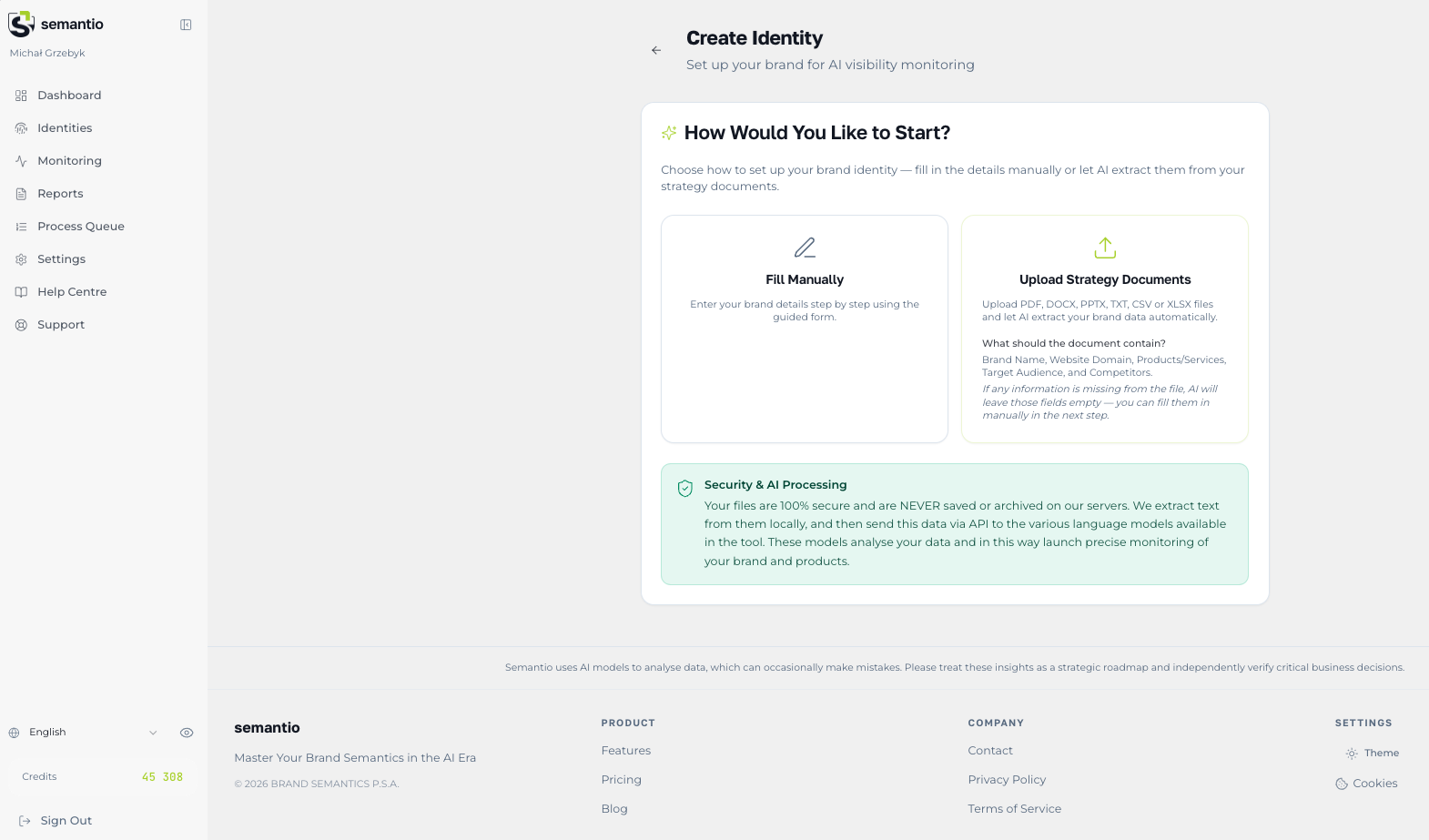
In the current version of Semantio, you can begin creating an Identity in two ways.
Fill Manually
The manual route leads through successive sections of the form. The user enters information about the brand, products, personas and competitors independently.
This is the recommended approach, particularly when:
he brand has a complex structure
the offer differs between markets
strategic documents contain a great deal of positioning language
the company operates in both B2B and B2C
part of the offer comes from external partners or manufacturers
the research covers only part of the portfolio
You need close control over every element
Manual entry is not valuable because it takes longer. It is valuable because it requires a series of deliberate decisions. Each name, boundary, category and relationship must be considered separately.
Upload Strategy Documents
The second route allows you to upload materials in formats indicated in the interface, including PDF, DOCX, PPTX, TXT, CSV and XLSX. Semantio can use them to extract information about the brand, domain, products, target groups and competitors. If a document does not contain the required information, the relevant field can remain empty for later completion.
This is a useful acceleration, but not a standalone method of understanding a brand. Why? A generative model cannot establish a correct Identity without suitable input material. Moreover, the quality of the result depends on the quality, currency and scope of the documents uploaded. If a strategic presentation contains aspirational positioning, broad values and comparisons with competitors, automated extraction may faithfully transfer precisely the content that will later undermine the neutrality of the research.
For this reason, a description generated from documents should be treated as a draft. Every field requires review by someone who knows:
which market the material relates to
whether the document describes the current state of the business
whether it presents the whole company, a particular brand or only a product line
which statements are facts
which statements express ambition or positioning
what the document does not contain at all
Automated extraction can speed up the work. It does not transfer responsibility for the scope and neutrality of the description from a person to a model.
Prepare the material before you start filling in fields
The best starting point is not a single website, but a small, organised set of sources.
It is worth preparing:
the official brand website and main domain
current product and service pages
catalogues, documentation, terms and conditions, price lists or technical materials
information about ownership structure and related entities
official brand profiles, if they help confirm the current scope of activity
knowledge held by people responsible for the product, sales and customers
a list of alternative names, abbreviations and historical variants that are still in circulation
a list of important gaps and disputed issues
The hierarchy matters. Materials supplied by the brand and official sources should take priority. Reliable external sources can confirm particular facts, but they should not be used to fill in information simply because it sounds plausible.
You should not build the description solely from search-result snippets either. They are taken out of context, may be outdated and do not show which entity the information refers to.
If an organisation does not yet have coherent materials, the problem may go beyond simply completing a form. In that case, the starting point may be to organise definitions, relationships and language as part of the brand semantic strategy.
Establish the research scope first
The first working sentence should be:
In this research, we analyse exactly...
Then complete it so that it leaves no room for several equally valid interpretations.
The scope should define:
the researched brand, company or institution
the country or region
the language
the B2B, B2C or hybrid model
the whole offer or a specified part of the portfolio
any geographical and organisational boundaries
important exclusions
Example:
In this research, we analyse a Polish brand that provides advice, installation and servicing for gates and doors in the domestic market. We do not attribute to it the full offer of the international manufacturer of which it is an authorised partner.
This sentence immediately separates two entities and prevents the offer from being expanded through association.
Another example:
In this research, we analyse an education brand that runs courses and events related to a specific development method. We distinguish between the brand, the creator of the method, the international organisation and the legal entities that provide the services.
Without this distinction, a model may state facts correctly about the method or its creator while failing to answer the question about the researched brand.
Separate entities before you begin describing them
A company may appear simultaneously as a trading brand, legal entity, local branch, distributor, authorised partner, member of a group or programme operator. These roles are not interchangeable.
Before completing the description, it is worth preparing a simple working table:
entity | relationship with the brand | is it part of the object of research? |
|---|---|---|
trading brand | main researched entity | yes |
operating company | owner or operator of the brand | depends on the scope |
international group | owner or organisational context | usually context only |
external manufacturer | product supplier | no, if it remains a separate brand |
technology partner | provides selected solutions | no |
sister brand | belongs to the same group | no, unless included in the research |
The purpose is not to expand the profile with the entire corporate history. It is to avoid mistakes that could later affect the assessment of model responses.
How to complete Brand Info
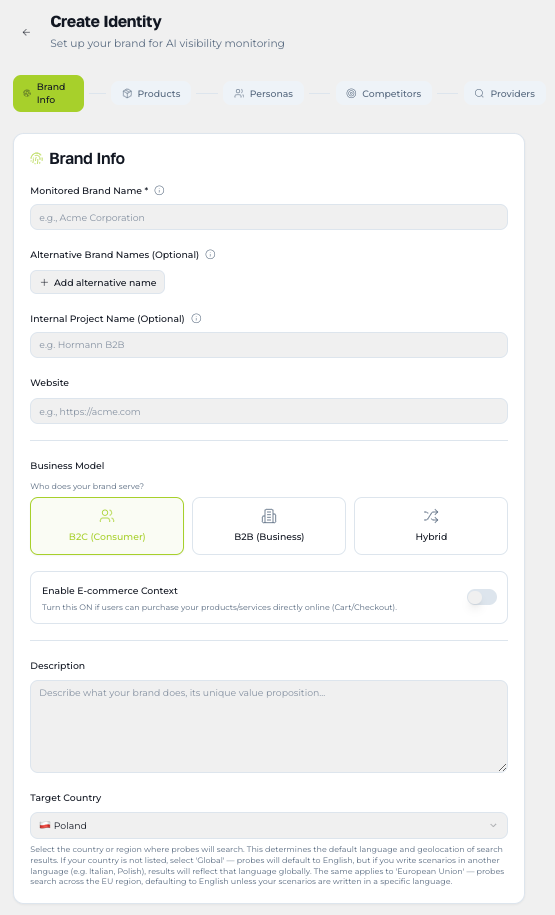
The Brand Info section collects core information about the entity being researched. Each field has a different function.
Remember that selecting a country is not a technical formality. The same brand may have a different offer, different competitors and different buying situations in Poland, Germany or the global market. If the geographical scope remains unclear, later responses may be correct for a market other than the one that matters to the organisation.
field | what should you enter? | what should you watch out for? |
|---|---|---|
Monitored Brand Name | The official, current name of the researched brand. | Do not enter both the brand and the whole group if they are separate entities. |
Alternative Brand Names | Genuine spelling variants, abbreviations and names used for the same entity. | Do not add partners, sister brands or the owner as aliases. |
Internal Project Name | A name that helps the team recognise the project, especially when you manage several projects. | This is an organisational label, not the public name of the brand. |
Website | The official main domain of the researched entity. | Do not provide the domain of a group, partner or external catalogue instead of the brand website. |
Business Model | B2C, B2B or Hybrid, according to the actual scope of activity. | Do not choose the model based on a single product. |
Enable E-commerce Context | Enable it if a user can genuinely buy a product or service online. | A contact form and product catalogue do not, by themselves, mean e-commerce. |
Description | A short, neutral and factual description. | Remove claims, aspirations, superlatives and positioning against competitors. |
Target Country | The market in which the research will be conducted. | The country affects the linguistic and geographical context of results. |
Start with a definition, not a measurement
If you want to check how AI models represent your brand, first prepare the sources and involve someone who knows its offer and organisational structure. Then create a new Identity in Semantio and give the Brand Info section as much attention as you would give to the assumptions of the entire study.
Because that is exactly what it is.
Semantio can later monitor responses from multiple systems consistently and show changes in brand representation. No measurement, however, can correct an ambiguous object of research. First, you need to build a reference point you can trust.
In Part II, we move on to creating a neutral brand description and organising the offer.