
Μέρος II | Ουδέτερες περιγραφές brand και η προσφορά
Μια ουδέτερη περιγραφή brand δεν δημιουργείται με τη συντόμευση της σελίδας "Σχετικά με εμάς". Πρέπει να διαχωρίσετε το πραγματικό πεδίο δραστηριότητας από τους ισχυρισμούς του brand και στη συνέχεια να το μεταφράσετε σε προϊόντα, υπηρεσίες και λύσεις που αντιστοιχούν σε πραγματικές καταστάσεις λήψης αποφάσεων. Αυτό το μέρος εξηγεί πώς να μεταβείτε από μια περιγραφή brand σε μια δομημένη προσφορά χωρίς να τροφοδοτείτε τα μοντέλα με ένα αναμενόμενο αποτέλεσμα.
Στο πρώτο μέρος αυτού του οδηγού, ορίσαμε το ερευνημένο brand, την αγορά, τη γλώσσα, τον τομέα και τα όρια των οντοτήτων. Αφαιρέσαμε την εμπορική γλώσσα, διαχωρίσαμε τα γεγονότα από τους ισχυρισμούς και καθορίσαμε γιατί η χειροκίνητη δημιουργία περιγραφών δίνει στους ανθρώπους τον μεγαλύτερο έλεγχο στα θεμέλια της έρευνας.
Αυτό είναι μόνο η αρχή.
Ένα όνομα εταιρείας και μόνο η περιγραφή της δεν αρκούν για να δημιουργηθούν χρήσιμα σενάρια. Οι άνθρωποι δεν ρωτούν τα μοντέλα μόνο για brands. Ρωτούν πώς να λύσουν ένα πρόβλημα, να επιλέξουν ένα προϊόν, να αξιολογήσουν μια υπηρεσία, να κατανοήσουν τις συνθήκες υλοποίησης, να μειώσουν τον κίνδυνο απόφασης ή να συγκρίνουν εναλλακτικές λύσεις.
Το επόμενο επίπεδο της Ταυτότητας πρέπει επομένως να δείχνει:
τι προσφέρει πραγματικά το brand
ποιος μπορεί να λάβει αποφάσεις για συγκεκριμένα μέρη της προσφοράς
ποιοι στόχοι, κριτήρια και περιορισμοί διαμορφώνουν αυτές τις αποφάσεις
ποια προϊόντα έχουν σημασία για ένα συγκεκριμένο persona
ποιες οντότητες μπορεί να είναι γνήσιες εναλλακτικές
πού συμβαίνει πραγματικά ο ανταγωνισμός
Εδώ μια γενική περιγραφή εταιρείας γίνεται ένα μοντέλο αγοράς που μπορεί να ερευνηθεί.
Πώς να γράψετε μια ουδέτερη περιγραφή brand
Μια καλή περιγραφή δεν χρειάζεται να είναι μεγάλη. Μία έως τρεις παράγραφοι είναι συνήθως αρκετές αν απαντούν στις θεμελιώδεις ερωτήσεις:
τι είναι η ερευνημένη οντότητα
σε ποια κατηγορία δραστηριοποιείται
ποια αγορά εξυπηρετεί
τι προσφέρει
ποια κοινά ή τομείς εξυπηρετεί, όπου αυτό μπορεί να επαληθευτεί
ποιες σχέσεις πρέπει να γίνουν κατανοητές για να αναγνωριστεί σωστά η οντότητα
ποιοι περιορισμοί έχουν σημασία
Η περιγραφή πρέπει να αναγνωρίζει το brand, όχι να το πουλάει.
Όχι καλό
Μια καινοτόμος εταιρεία με πολυετή εμπειρία, που προσφέρει ολοκληρωμένες, υψηλής ποιότητας λύσεις προσαρμοσμένες στις ανάγκες των πελατών. Χάρη στην αφοσιωμένη ομάδα της και τη συνεχή προσοχή στην ανατροφοδότηση της αγοράς, το brand θέτει πρότυπα στον κλάδο του.
Μόλις αφαιρεθεί το όνομα της εταιρείας, αυτή η περιγραφή θα μπορούσε να εφαρμοστεί σε εκατοντάδες οργανισμούς. Δεν ορίζει την κατηγορία, την αγορά, το πεδίο εφαρμογής της προσφοράς ή τα όρια της ερευνημένης οντότητας.
Καλύτερο
Μια πολωνική εταιρεία που πωλεί, συμβουλεύει, εγκαθιστά και συντηρεί οικιακές και βιομηχανικές πόρτες, πύλες, συστήματα αυτοματισμού και εξοπλισμό χώρων φόρτωσης. Εξυπηρετεί ιδιώτες πελάτες και επιχειρήσεις σε τοπικές και περιφερειακές αγορές. Είναι εξουσιοδοτημένος συνεργάτης ενός κατασκευαστή του οποίου επιλεγμένα προϊόντα χρησιμοποιεί στα έργα της, παραμένοντας ταυτόχρονα μια ξεχωριστή οντότητα.
Γιατί αυτή η περιγραφή είναι καλύτερη; Επειδή μπορεί να επαληθευτεί. Εξηγεί τι κάνει η εταιρεία, ποιον εξυπηρετεί, σε ποια αγορά δραστηριοποιείται και ποια οργανωτική σχέση μπορεί να προκαλέσει σύγχυση.
Αφαιρέστε το marketing filler
Οι λέξεις-κλειδιά ακούγονται ασφαλείς, θετικές και επαγγελματικές. Αλλά μόνο έτσι ακούγονται. Μεταφέρουν ελάχιστες πληροφορίες. Το πρόβλημά τους είναι ότι αυξάνονται σχεδόν σε κάθε περιγραφή brand, παίρνοντας τη θέση πληροφοριών που πραγματικά έχουν σημασία.
Σε αυτή την κατηγορία περιλαμβάνονται, μεταξύ άλλων:
καινοτόμος εταιρεία
ολοκληρωμένη προσφορά
υψηλότερη ποιότητα
σύγχρονες λύσεις
ατομική προσέγγιση
αξιόπιστος συνεργάτης
αφοσιωμένη ομάδα
ακούγοντας τις ανάγκες των πελατών
λύσεις προσαρμοσμένες στις ανάγκες
πολυετής εμπειρία, εκτός αν σχετίζεται με ένα συγκεκριμένο και ουσιαστικό γεγονός
Αξίζει να ελέγξετε κάθε πρόταση με τέσσερις ερωτήσεις:
περιέχει πληροφορίες που μπορούν να επαληθευτούν
βοηθά στην αναγνώριση της οντότητας, της προσφοράς, της αγοράς ή του περιορισμού
θα μπορούσε να εμφανιστεί αμετάβλητη στις περιγραφές εκατό άλλων εταιρειών
περιγράφει το brand, ή υποδηλώνει πώς πρέπει να κριθεί το brand
Εάν μια πρόταση ταιριάζει σχεδόν σε οποιαδήποτε εταιρεία ή προσπαθεί να καθορίσει μια προτιμώμενη κρίση, αφαιρέστε την.
Αξίζει επίσης να θυμόμαστε ότι οι λέξεις-κλειδιά, οι όροι κατηγορίας, οι οντότητες και οι σχέσεις εκτελούν διαφορετικές λειτουργίες. Το άρθρο Οι λέξεις-κλειδιά δεν είναι οντότητες απεικονίζει καλά αυτή τη διάκριση. Η Ταυτότητα δεν αφορά τη συλλογή ελκυστικών φράσεων. Αφορά τη δημιουργία ενός αδιαμφισβήτητου μοντέλου της ερευνημένης περιοχής.
Μην τοποθετείτε το brand έναντι των ανταγωνιστών
Μια περιγραφή brand δεν πρέπει να περιλαμβάνει δηλώσεις όπως:
«προσφέρει πιο ευέλικτη εξυπηρέτηση από τις μεγάλες εταιρείες»
«είναι μια τοπική εναλλακτική λύση στις ακριβές αλυσίδες»
«ξεχωρίζει μέσω υψηλότερης ποιότητας και ταχύτερης εξυπηρέτησης»
«είναι μεταξύ των πιο προηγμένων παρόχων στη χώρα»
Ακόμα κι αν ο οργανισμός χρησιμοποιεί τέτοια επιχειρήματα στις επικοινωνίες του, δεν αποτελούν ουδέτερη περιγραφή της ερευνημένης οντότητας. Μπορεί να επηρεάσουν τον τρόπο κατασκευής των σεναρίων και να παραμορφώσουν την μεταγενέστερη αξιολόγηση της αναπαράστασης του brand σε μεγάλα γλωσσικά μοντέλα.
Οι ανταγωνιστές έχουν ξεχωριστή ενότητα. Θα πρέπει επίσης να περιγράφονται με βάση τα γεγονότα, προσδιορίζοντας την κατηγορία τους, την αγορά, το επιχειρηματικό τους μοντέλο και το εύρος της επικάλυψης μεταξύ των προσφορών.
Με απλά λόγια, η Ταυτότητα δεν είναι το μέρος για να αποδείξετε ότι το ερευνημένο brand έχει πλεονέκτημα έναντι αυτών. Δεν είναι ένα ποίημα για το διοικητικό συμβούλιο.
Εάν θέλουμε να ελέγξουμε αν τα μοντέλα αντιλαμβάνονται αυθόρμητα ένα brand ως καινοτόμο, ευέλικτο ή καλύτερο στην εξυπηρέτηση πελατών, δεν μπορούμε πρώτα να εισάγουμε αυτές τις κρίσεις στα θεμέλια της έρευνας. Ο σκοπός της έρευνας είναι να αποκαλύψει την αναπαράσταση του brand, όχι να αναπαράγει την αυτοπαρουσίαση που του παρέχεται.
Μην κρύβετε τα κενά
Μια πλήρης φόρμα δεν σημαίνει πάντα μια καλά προετοιμασμένη φόρμα.
Εάν δεν γνωρίζουμε αν μια συγκεκριμένη υπηρεσία είναι ακόμα διαθέσιμη, αν ένα προϊόν προσφέρεται στην ερευνημένη αγορά ή αν ένα brand χρησιμοποιεί πραγματικά ένα συγκεκριμένο ψευδώνυμο, υπάρχουν αρκετές ειλικρινείς επιλογές:
ελέγξτε μια πρόσθετη πηγή
ρωτήστε τον ιδιοκτήτη αυτής της περιοχής
σημειώστε την πληροφορία για επιβεβαίωση
εξαιρέστε την από το τρέχον πεδίο
επιστρέψτε σε αυτήν όταν ενημερωθεί η Ταυτότητα
Μην μετατρέπετε πιθανές πληροφορίες σε βεβαιότητα απλά για να αποφύγετε να αφήσετε ένα πεδίο κενό. Εδώ, ένα άτομο έχει ένα σημαντικό πλεονέκτημα έναντι ενός γενετικού μοντέλου: μπορεί να πει, «Δεν το γνωρίζω ακόμα», χωρίς να αισθάνεται την ανάγκη να καλύψει το κενό με τρεις παραγράφους με πιθανότατο κείμενο.
Ένα σαφές κενό είναι ορατό και μπορεί να επιλυθεί. Μια άψογα γραμμένη ανακρίβεια μπορεί να παραμείνει ένα αόρατο σφάλμα καθ' όλη τη διάρκεια της έρευνας.
Έλεγχος ποιότητας πριν τη μετάβαση στην προσφορά
Πριν εγκρίνετε τις Πληροφορίες Brand, ελέγξτε:
αν το όνομα προσδιορίζει ακριβώς το brand που σκοπεύετε να ερευνήσετε
αν τα ψευδώνυμα αναφέρονται στην ίδια οντότητα
αν το brand έχει συγχωνευθεί με τον ιδιοκτήτη, τον όμιλο, τον συνεργάτη ή τον διανομέα του
αν ο τομέας είναι επίσημος και κατάλληλος για την ερευνημένη αγορά
αν το μοντέλο B2B, B2C ή υβριδικό αντικατοπτρίζει το πεδίο εφαρμογής του έργου
αν το ηλεκτρονικό εμπόριο έχει ενεργοποιηθεί μόνο όπου οι αγορές πραγματοποιούνται πραγματικά online
αν η περιγραφή περιλαμβάνει την κατηγορία, την προσφορά, την αγορά και τις ουσιαστικές σχέσεις
αν έχουν αφαιρεθεί τα υπερθετικά, οι ισχυρισμοί και οι κενοί buzzwords
αν η περιγραφή αποφεύγει την τοποθέτηση του brand έναντι των ανταγωνιστών
αν κάθε σημαντικό γεγονός έχει πηγή
αν η αβεβαιότητα έχει επισημανθεί αντί να συγκαλυφθεί
αν κάποιος που γνωρίζει το brand έχει εγκρίνει το πεδίο εφαρμογής
Εάν οι απαντήσεις είναι θετικές, έχετε δημιουργήσει το πρώτο επίπεδο ενός αξιόπιστου μοντέλου αναφοράς.
Αυτή δεν είναι ακόμα μια πλήρης Ταυτότητα. Ένα brand αρχίζει να λειτουργεί στην έρευνα μόνο όταν συνδέεται με την προσφορά του, τους ανθρώπους που λαμβάνουν αποφάσεις και τις πραγματικές εναλλακτικές λύσεις της αγοράς. Προχωράμε τώρα σε αυτές τις σχέσεις.
Μην αντιγράφετε την πλοήγηση του ιστότοπου στη λίστα προϊόντων
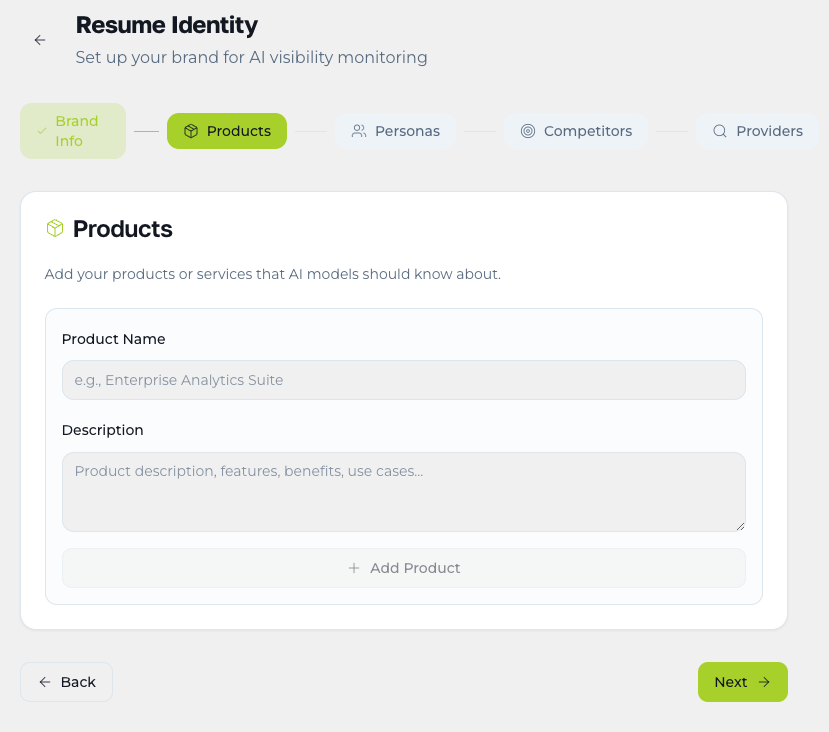
Η ενότητα Προϊόντα περιέχει δύο βασικά πεδία: όνομα και περιγραφή. Η απλότητα της διεπαφής δεν σημαίνει ότι πρέπει απλά να αντιγράψετε τη δομή της πλοήγησης ενός ιστότοπου.
Η πλοήγηση δημιουργείται για πολλούς λόγους. Μπορεί να αντικατοπτρίζει την οργανωτική δομή μιας εταιρείας, την ιστορία του ιστότοπου, τις απαιτήσεις SEO ή μια καθιερωμένη προσέγγιση πωλήσεων. Δεν αντιστοιχεί πάντα στον τρόπο με τον οποίο ένας δυνητικός πελάτης αναγνωρίζει ένα πρόβλημα και αναζητά μια λύση.
Η Ταυτότητα χρειάζεται μια δομή έρευνας:
ομάδα προσφοράς → προϊόν, υπηρεσία ή λύση → περίπτωση χρήσης και πλαίσιο απόφασης
Για κάθε στοιχείο, καθορίστε:
το όνομα που χρησιμοποιείται από το brand ή ένα ουδέτερο όνομα κατηγορίας
τον τύπο: προϊόν, υπηρεσία, λύση, σειρά ή ομάδα προσφοράς
λειτουργία και περίπτωση χρήσης
περιορισμοί αγοράς ή διαθεσιμότητας
κοινά ή καταστάσεις χρήσης, όπου αυτά μπορούν να επαληθευτούν
πηγή πληροφοριών
Να θυμάστε ότι η περιγραφή πρέπει να παραμένει ουδέτερη. Ένα πεδίο προϊόντος δεν είναι το μέρος για φράσεις όπως «υψηλότερη ποιότητα», «πρωτοποριακή τεχνολογία» ή «ασύγκριτη ευκολία». Εάν αναφέρετε ένα όφελος, θα πρέπει να προκύπτει από μια συγκεκριμένη λειτουργία ή τεκμηριωμένη περίπτωση χρήσης.
Βρείτε το σωστό επίπεδο λεπτομέρειας
Τα πιο συνηθισμένα λάθη βρίσκονται σε δύο άκρα.
Πολύ γενικό
Μια εταιρεία που προμηθεύει οικοδομικό εξοπλισμό περιγράφεται με μια μόνο φράση:
πόρτες, πύλες και αυτοματισμοί
Αυτό το στοιχείο συνδυάζει πολλές διαφορετικές αποφάσεις. Η αγορά μιας οικιακής γκαραζόπορτας, η επιλογή μιας βιομηχανικής πόρτας υψηλής ταχύτητας για μια αποθήκη, η αποδοχή μιας πυράντοχης πόρτας και η επισκευή ενός συστήματος αυτοματισμού δεν είναι το ίδιο σενάριο.
Πολύ λεπτομερές
Κάθε διάσταση, χρώμα, υλικό, μοντέλο τηλεχειριστηρίου και παραλλαγή φινιρίσματος γίνεται ξεχωριστό προϊόν. Το αποτέλεσμα είναι μια μακρά λίστα που φαίνεται εντυπωσιακή αλλά δεν προσθέτει νέο πλαίσιο απόφασης. Εάν δύο παραλλαγές αξιολογούνται από το ίδιο άτομο, στην ίδια κατάσταση και με τα ίδια κριτήρια, συνήθως δεν χρειάζεται να διαχωριστούν στην Ταυτότητα.
Το σωστό επίπεδο βρίσκεται μεταξύ αυτών των άκρων. Ένα ξεχωριστό στοιχείο έχει νόημα όταν αντιπροσωπεύει ένα διακριτό πρόβλημα, περίπτωση χρήσης, ομάδα κριτηρίων ή διαδικασία επιλογής.
Παράδειγμα: μια προσφορά για σπίτια και βιομηχανικές εγκαταστάσεις
Εξετάστε μια ανώνυμη εταιρεία που πωλεί, συμβουλεύει, εγκαθιστά και συντηρεί λύσεις για σπίτια, αποθήκες και βιομηχανικές εγκαταστάσεις.
Μια χρήσιμη δομή θα μπορούσε να περιλαμβάνει:
αυτοματισμοί και μηχανισμοί πυλών
γκαραζόπορτες
βιομηχανικές πόρτες
εξωτερικές πόρτες για σπίτια
τεχνικές και πυράντοχες πόρτες
συστήματα ελέγχου πρόσβασης
εξοπλισμός χώρων φόρτωσης
συμβουλευτική, επιλογή και εγκατάσταση
συντήρηση, επισκευές και service
Αυτή η λίστα διαχωρίζει φυσικά τα προϊόντα από τις υπηρεσίες και διατηρεί διαφορετικές καταστάσεις λήψης αποφάσεων. Ωστόσο, δεν διαιρεί κάθε πόρτα ή πύλη ανά χρώμα, διάσταση ή ατομική τεχνική παράμετρο.
Οι περιγραφές μπορούν να διευκρινίσουν ότι η επιλογή μιας βιομηχανικής πόρτας εξαρτάται, μεταξύ άλλων, από την ένταση χρήσης, τις διαστάσεις ανοίγματος, τη μόνωση, την οργάνωση της κυκλοφορίας και τη μέθοδο ελέγχου. Για τη συντήρηση, μπορούν να προσδιορίσουν τη διάγνωση, την επισκευή, τη ρύθμιση, τα ανταλλακτικά, τον εκσυγχρονισμό και τη συντήρηση. Αυτές οι λεπτομέρειες βοηθούν στην επεξήγηση του πεδίου εφαρμογής. Δεν αποτελούν κρίση μάρκετινγκ για την ποιότητα.
Το παράδειγμα δείχνει επίσης γιατί μια υποστηρικτική υπηρεσία δεν πρέπει να εξαφανίζεται μέσα σε μια περιγραφή προϊόντος. Κάποιος μπορεί να αναζητά όχι μόνο μια πόρτα ή πύλη, αλλά και μέτρηση, εγκατάσταση, θέση σε λειτουργία ή μεταγενέστερη συντήρηση. Κάθε μία από αυτές τις ανάγκες μπορεί να οδηγήσει σε ξεχωριστές ερωτήσεις που απευθύνονται στην AI.
Παράδειγμα: ένα brand, διάφοροι τρόποι χρήσης της προσφοράς
Για ένα brand εκπαίδευσης ή προσωπικής ανάπτυξης, η προσφορά μπορεί να έχει διαφορετική δομή:
δωρεάν εργαλείο αυτοδιδασκαλίας
επί πληρωμή ψηφιακό υλικό
θεματικά εργαστήρια
ομαδική εκδήλωση
ατομικές συνεδρίες
μάθημα προετοιμασίας συμμετεχόντων για επαγγελματική πρακτική
mentoring για άτομα που έχουν ολοκληρώσει το μάθημα
Όλα αυτά τα στοιχεία μπορεί να σχετίζονται με την ίδια μέθοδο, αλλά αντιστοιχούν σε διαφορετικές ανάγκες, στάδια και συνθήκες συμμετοχής. Κάποιος που εξερευνά ένα θέμα ανεξάρτητα δεν λαμβάνει την ίδια απόφαση με έναν υποψήφιο για ένα πιστοποιημένο μάθημα. Ένας πιστοποιημένος επαγγελματίας που αναπτύσσει την πρακτική του δεν είναι το ίδιο κοινό με κάποιον που παρακολουθεί μια εφάπαξ εκδήλωση.
Γιατί έχει σημασία αυτό; Εάν ολόκληρη η προσφορά τοποθετούνταν κάτω από την ετικέτα «μαθήματα και προσωπική ανάπτυξη», αυτές οι διαφορές θα εξαφανίζονταν από το μοντέλο έρευνας.
Ένα προϊόν πρέπει να περιγράφει το πεδίο εφαρμογής, όχι την τοποθέτηση
Μια περιγραφή προϊόντος πρέπει να απαντά:
τι είναι το αντικείμενο
ποιο πρόβλημα επιλύει ή ποια λειτουργία εκτελεί
σε ποιες καταστάσεις χρησιμοποιείται
σε ποιους είναι διαθέσιμο
ποιους σημαντικούς περιορισμούς έχει
αν απαιτεί προηγούμενο στάδιο, προσόν ή άλλο προϊόν
Δεν πρέπει να απαντά εκ μέρους των μεγάλων γλωσσικών μοντέλων:
αν το προϊόν είναι το καλύτερο
αν είναι πιο προηγμένο από τους ανταγωνιστές
αν προσφέρει εξαιρετική ποιότητα
αν οι πελάτες το αγαπούν
αν το brand θέτει πρότυπα στην αγορά μέσω αυτού
Αξίζει να επαναλάβουμε: εάν θέλουμε να ερευνήσουμε αν τέτοιες αξιολογήσεις εμφανίζονται στις απαντήσεις της γενετικής AI, δεν μπορούμε πρώτα να τις εισάγουμε ως μέρος του ορισμού του προϊόντος.
Μια σαφώς καθορισμένη οντότητα και προσφορά διευκολύνουν τη δημιουργία σεναρίων, την αξιολόγηση της ακρίβειας των απαντήσεων και τη διάκριση ενός γνήσιου ζητήματος αναπαράστασης από ένα σφάλμα στη ρύθμιση της έρευνας. Αυτή είναι η ίδια αρχή που διέπει έναν αυστηρό έλεγχο ορατότητας AI.
Στο μέρος III, προχωράμε στα personas, αναθέτοντας τα σωστά προϊόντα σε αυτά και ορίζοντας τους ανταγωνιστές εντός συγκεκριμένων αποφάσεων.